Polish Embassy Blasts Tucker Carlson Over WWII Remarks
Washington, D.C., October 2026 — A letter from Poland’s embassy in Washington has sharply criticized commentator Tucker Carlson for comments he made about the origins of World War II, accusing him of justifying Nazi Germany’s invasion of Poland. The exchange has drawn attention to Carlson’s broader, long-standing arguments against American military interventions and foreign wars that he says deliver little benefit to ordinary Americans.
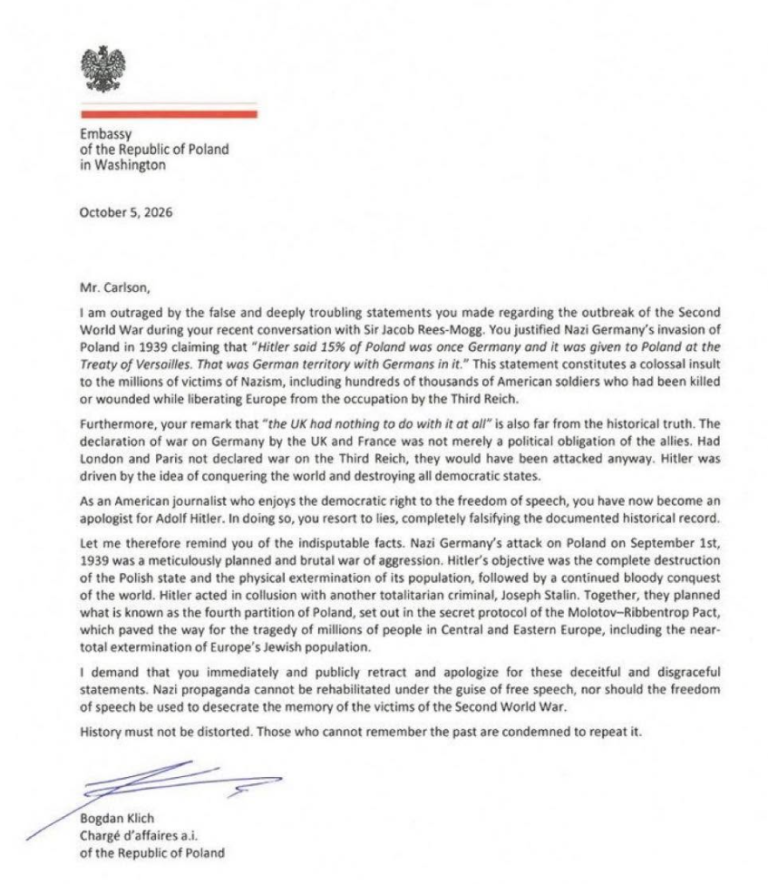
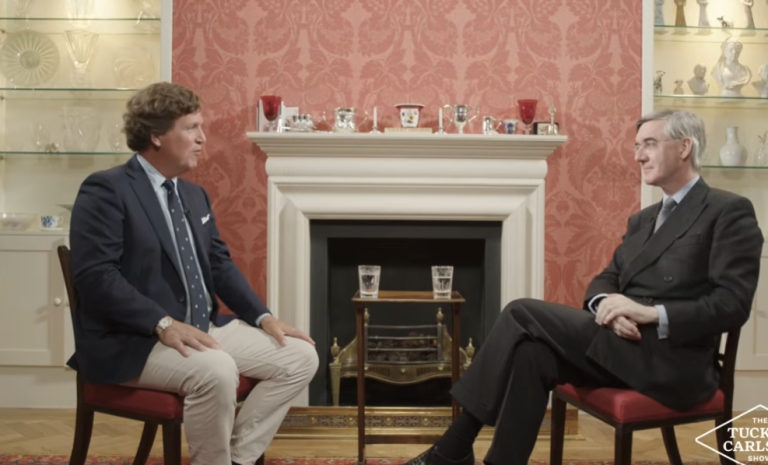
In the October 5 letter, Chargé d’affaires a.i. Bogdan Klich said he was “outraged” by Carlson’s remarks during a conversation with British politician Sir Jacob Rees-Mogg. Carlson had noted that Hitler claimed roughly 15 percent of Poland had previously been German territory transferred under the Treaty of Versailles, describing it as “German territory with Germans in it,” and questioned why the United Kingdom entered the war. Klich called the statements a “colossal insult” to the victims of Nazism, including American soldiers, and labeled Carlson an “apologist for Adolf Hitler.” He demanded a public retraction and apology, arguing that the comments falsified the historical record.
The embassy’s response frames Carlson’s words as historical revisionism. At the same time, the episode fits a pattern in Carlson’s commentary: repeated skepticism of foreign wars and large-scale U.S. military commitments. For years he has argued that American involvement in overseas conflicts often fails to serve the interests of working- and middle-class Americans, who bear the costs in lives, taxes, and opportunity while seeing limited strategic or economic returns at home. He has applied this critique to post-9/11 wars, ongoing aid packages, and debates over U.S. posture in Europe and elsewhere.
In the Rees-Mogg interview, Carlson’s comments about 1939 sat alongside questions about why Britain (and by extension the United States) entered a continental European war. Rees-Mogg pushed back, saying Carlson was “verging on defending Hitler.” Carlson has maintained that examining the stated grievances and decision points that led to war is distinct from endorsing the Nazi regime’s later crimes. The Polish letter treats the two as inseparable.
The letter was published by the embassy and widely reported. As of mid-October, Carlson had not issued a direct public reply. The exchange highlights a familiar tension: governments and institutions that view certain historical interpretations as off-limits versus commentators who treat skepticism of interventionist foreign policy—including the chain of events that pulled the United States into major wars—as a legitimate subject of debate.
Whether Carlson’s specific historical claims about the Treaty of Versailles and the 1939 invasion hold up is contested by the Polish embassy and many historians. His larger point—that American military spending and foreign entanglements have frequently failed to deliver clear gains for the American public—continues to resonate with audiences who share his doubts about open-ended commitments abroad.