
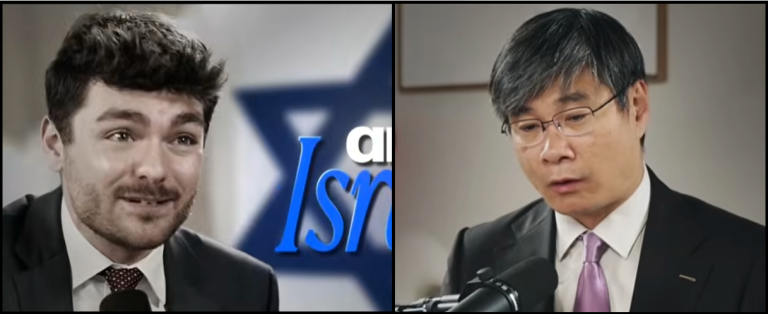
Fuentes and Jiang discuss the globalist problem and Israel.
On 26 September 2026, the American podcaster Jack Neel — a former debate champion from Kentucky, now host of the Jack Neel Podcast — released episode 113: Nick Fuentes vs Professor Jiang: Who Actually Runs the World? The conversation runs a little over three hours. More than a million people had already watched it within 24 hours of publication.
On one side sits Nick Fuentes, the American right-wing commentator behind the America First movement, known for ethnic nationalism, Catholic traditionalism, and the claim that Israel and Jewish group loyalty steer Washington more than the American national interest.
On the other side sits “Professor Jiang.” His real name is Jiang Xueqin (江学勤), born in 1976 in Guangdong, raised in Toronto, Yale-educated, a high-school teacher in Beijing, and the face of the YouTube channel Predictive History. The title professor is an online persona, not a university post.
The two men discuss who runs the world. They largely agree on almost everything that counts politically: the liberal global order is finished, America can no longer be governed in the ordinary way, and someone has to break the deadlock. The difference is the language they use, and some of the tools of analysis.
Fuentes answers in ethnic and national terms. The world is run by states, intelligence services, and cohesive peoples. The group he keeps returning to is Jews as a collective actor, and Israel as the magnet that bends Washington. He dismisses secret societies. Freemasons in small towns are not a world government. Power is visible enough if you look at lobbying, money, and war.
Jiang answers in cyclical and esoteric terms. The world is run by transnational capital, rites, societies, and a religious timetable. Trump is not just a businessman. He is an instrument in a messianic calendar: temple, end times, a staged salvation. Ashkenazi Jews are explained with the Khazar hypothesis. Jesus is a poet, not God. Paul built the church’s pyramid.
Set the fight aside for a minute. Both men are, in practice, anti-globalists. Both argue that the open world after 1945 — markets, institutions, the “rules-based order,” endless growth — was a skin over something older. Both treat around 2001 as the end of the good years. Both see AI surveillance as the next shell. Both can imagine a dictatorial knot tied in the American knot.
These are not two liberals arguing about tax rates. These are two men who have already left liberal time.
Fuentes: the people as substance
Fuentes’s conservatism is not Burke in a club armchair. It is a people as a body. Anglo-America, the white majority, the Catholic form, the nation as kin rather than contract. In that lens, globalism is not just McDonald’s and the IMF. It is a people ceasing to be a subject and becoming administered material.
That is why “who rules?” becomes, for him, a question of which group has the tightest loyalty. The nation-state is real. A diaspora that acts across states is suspect. Israel is not an ally among others. It is the will to which U.S. foreign policy bends.
This is an old right-wing figure: the world explained by cohesion. Whoever holds together beats whoever is only an individual and a market. Fuentes hates the global elite not mainly because it is rich, but because, in his account, it is not a people among other peoples. It is a network that parasitizes the host nation.
That is also why he does not need Jesuits in the basement. If the group is already the actor, the lodge is superfluous. The conspiracy is open: donations, media, war resolutions, taboos. He calls Trump a buffoon precisely because Trump does not understand that game. He only reacts to it.
The price of that map is well known. When “Jews” become the central explanatory variable, the analysis collapses a small state, a heterogeneous diaspora, a lobby, and a religion into a single subject. That is not the same as saying AIPAC is powerful, or that Israel has a special place in Washington. The latter can be argued with documents. The former is a collective myth. The debate at Neel’s table keeps sliding between the two.
Jiang: time as organism
Jiang sounds more like a mix of preacher and game theorist. He does not first of all want to save a race. He wants to read where we are in the cycle.
Here the kinship with organic conservatism enters — not necessarily as a citation he puts on the table, but as a form. Joseph de Maistre said society is not a contract people sign in the morning. It is a chain of the dead, the living, and the unborn, held by authority, sacrifice, and fear of God. Amaury de Riencourt wrote of Caesar: the republic ripens, swells, tires, and calls for a man who binds chaos into will. History is not progress. It is a season.
Jiang’s eschatology is the religious version of the same clock. Liberalism believed time was a straight line: more trade, more rights, more reason. Jiang says the line is an illusion. There is harvest and there is winter. The temple, the war, the surveillance state, the staged savior — that is not “policy.” It is season.
Secret societies fill, for him, the same function providence filled for de Maistre: invisible form behind visible politics. Transnational capital is not just BlackRock. It is a church without a crucifix. Trump then is not a national father in Fuentes’s sense, but an instrument time is using. Chabad, the Third Temple, Iran as a fuse — all of it is scenery for a cycle that is supposed to close.
That makes Jiang less a “race ideologue” and more a philosopher of reaction. Races mix anyway, he says. Find an Asian wife, he jokes at Fuentes. The point is not blood. The point is that the modern individual is too weak for the time that is coming. The organ must become hierarchy again.
There is a price here too. The Khazar hypothesis is not the genetic consensus on Ashkenazi Jews. “The lodge rules” is almost impossible to falsify. When everything is ritual, every war becomes proof. The cycle explains too much, and therefore too little.
Anti-globalism as a shared church
Call it what they do not call it: both reject the global individual.
The globalist says: you are a consumer, a rights-bearer, labor. Your loyalties should be thin so goods and data can move. The state should be a platform. Religion should be private. History should be shame or a museum.
Fuentes answers with a people. Jiang answers with time and mystery. The result is similar. Neither can accept EU-speak, Davos-speak, the “liberal international order” as morality. Both see supranational flows as dissolution. Both want a thicker reality: church, blood, rites, Caesar.
That is why they can agree on the dictator without agreeing on the people. Fuentes’s dictator is the one who saves the tribe. Jiang’s dictator is the one who closes the cycle — the Caesar Riencourt saw coming when the republic can no longer bear to be a republic. For de Maistre the Revolution was the disease and the king the cure. For Jiang, 1990s globalization is the disease, and the hard state — plus the religious calendar — is the cure. For Fuentes the cure is that America stop being a boarding house for everyone else’s projects.
That is why the conversation about Iran and Israel runs so long. Not because they love maps. Because the Middle East is the place where liberal time claims to be neutral (“security,” “non-proliferation,” “alliances”) while both guests hear older music: temple, end, chosen people, empire.
Theology as the dividing line
Here they are not anti-globalists in the same way. They are different churches.
Fuentes’s Catholic Christology is a wall. Jesus is God. Deny that and you have left the West as he defines it. The Church is truth, not merely civil religion.
Jiang’s Jesus is genius and miracle. Making him God is, in Jiang’s account, the seed of ecclesiastical tyranny. Paul organized. Hierarchy is the fault, not the cure — until Jiang, in the next breath, wants hierarchy in politics. That is a crack: spiritually egalitarian, politically Caesarian.
The crack is typical of late-modern reaction. You hate the liberal church (media, universities, HR) but you do not want to return to the same dogma. Fuentes wants to return to the dogma. Jiang wants to return to the form — cycle, sacrifice, elite — without kneeling to the Trinity.
That is why Fuentes is irritated by Jiang’s Christology as heresy, and Jiang is irritated by Fuentes’s racial doctrine as too small. One thinks eternal truth in the flesh. One thinks eternally recurring patterns in history.
What actually unites them against “the system”
Strip away the fight over Jews, lodges, and Jesus, and a shared diagnosis remains, one many anti-globalists share, from right-wing populists to some left sovereigntists:
America can no longer produce consent.
The institutions do not trust the people and the people do not trust the institutions.
Wars in the Middle East have eaten the domestic peace.
The technology points toward control, not freedom.
The old center — parties, newspapers, “normal” Republicans and Democrats — is administering a corpse.
There the likeness in method ends. Fuentes wants to ethnicize the conflict: name a group, end the wars that are not “ours,” save the demographic core. Jiang wants to mythologize the conflict: read the signs, wait for winter, accept that Caesar and surveillance arrive like weather.
The first path slides easily into a scapegoat. The second slides easily into fatal passivity: it was all already written.
De Maistre, Riencourt, and the American temptation
De Maistre wrote after the French Revolution that reason had slaughtered the body and then wondered why the corpse would not dance. Riencourt saw in America a young culture that would age fast and demand a Caesar when the parties were only theater.
The Neel debate is the American version, 2026. Fuentes is the people that refuses to become “humanity.” Jiang is the clock that refuses to become progress. Both look at Trump and see different animals: one a fool who happens to stand in the way of the lobbies, the other a messianic extra in someone else’s liturgy.
Neither defends the WTO world. Neither believes more free-trade deals will heal 2001. Neither wants more “global civil society.” They are anti-globalists who cannot stand each other’s metaphysics.
Conclusion
“Who runs the world?” is the wrong headline. The right one is: what is supposed to replace global time?
Fuentes’s answer: a people with memory, church, and a border.
Jiang’s answer: a cycle with elite, rite, and conservative hierarchy.
The shared answer: not Davos, not the eternal present, not the individual as the only measure.
That is why they can sit for three hours sounding like enemies and still end on the same sentence: the system is broken, and the soft republic is not enough. One wants to save the tribe from the world. The other wants the world to become a season again. Anti-globalism is the roof. Under the roof there are two different religions.
