
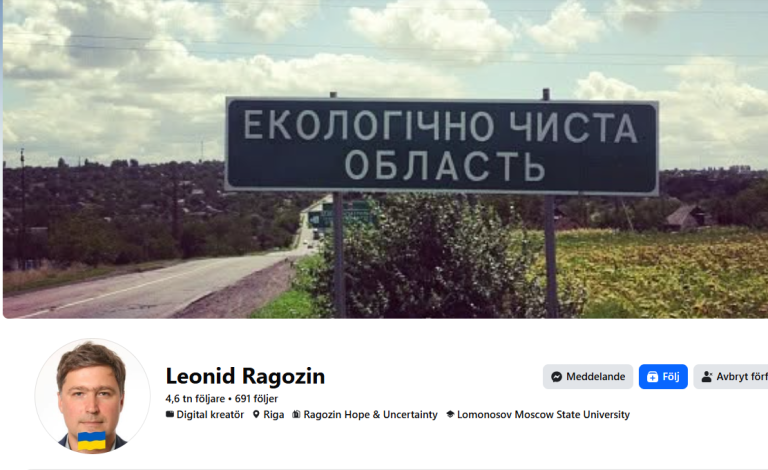
Ex BBC Journalist, Neutral on Russia, and Threat of Expulsion from Latvia
How a former BBC journalist who left Putin’s Russia became the subject of a n
How a former BBC journalist who left Putin’s Russia became the subject of a national-security controversy in the European Union.
October 8, 2026
A Journalist Caught Between Russia and the West
For more than a decade, Leonid Ragozin has made his home in Latvia, a Baltic country that borders Russia and has become one of Moscow’s most outspoken European critics. A veteran Russian journalist who worked for the BBC Russian Service and contributed to numerous Western publications, Ragozin built his career on explaining Russia and the former Soviet Union to international audiences.
Now he faces the prospect of being forced to leave the country where he has lived since 2014.
On October 6, Latvian Foreign Minister Baiba Braže announced proceedings to place an unnamed Russian citizen on the country’s list of personae non gratae. Latvian media identified the individual as Ragozin, and subsequent reporting confirmed that he was the subject of the action.
The controversy centres on his public commentary about Russia’s invasion of Ukraine, Western sanctions, the possibility of a negotiated peace and the role of Western governments in the conflict.
To his critics, Ragozin has increasingly adopted arguments that serve Russian interests, even when he presents them as geopolitical analysis. To his defenders, he is an independent journalist whose criticism of Western and Ukrainian policies should not be confused with support for Vladimir Putin.
The dispute raises a larger question: how should a democratic country distinguish between legitimate dissent and speech that it considers a threat to national security?
From Moscow to the BBC and Western Journalism
Ragozin’s professional background complicates any attempt to portray him simply as a representative of the Russian state.
He worked for the BBC Russian Service during two periods, from 1998 to 2006 and again from 2010 to 2013. He also served as an editor at Russian Newsweek and contributed to international outlets including The Guardian, Al Jazeera, Bloomberg, Politico and other publications.
His work has extended beyond political reporting. He has co-authored numerous Lonely Planet travel guides, reflecting a career that has involved extensive travel and reporting across different societies.
In Russia, he was not always on the side of the authorities. According to an October 2026 account published by bne IntelliNews, Ragozin participated in the anti-government demonstrations that followed Russia’s disputed parliamentary elections in 2011. The publication reports that Russian police arrested him during those protests.
His opposition to aspects of Putin’s rule was therefore not merely theoretical.
Following Russia’s annexation of Crimea in 2014, Ragozin relocated from Moscow to Latvia. He continued reporting and writing about Russia and Ukraine while living in Riga.
For a time, he also collaborated with Re, the Baltic Centre for Investigative Journalism. In a statement issued in October 2026, Re confirmed that it had worked with him on several investigations after his relocation.
The organization said that the collaboration had been based on his professional experience and reputation at the time. However, it emphasized that it had not worked with him since 2019 and would not do so again, describing many of his more recent social-media statements as unacceptable.
That response illustrates how sharply perceptions of Ragozin have changed.
His Position on the War: Neutrality, Realism or a Russian Perspective?
Describing Ragozin as neutral on the Russia–Ukraine war is understandable in one sense, but it requires qualification.
He is not a neutral observer in the sense of having no political opinions. His published articles contain strong criticism of Western governments, Ukrainian leaders and the strategic assumptions underlying Western support for Ukraine.
Nor does his record support a simple claim that he has always defended the Kremlin.
In a 2014 article for The Guardian, he challenged Vladimir Putin’s denial that regular Russian military forces were operating in eastern Ukraine. After Russia’s full-scale invasion in February 2022, he publicly reflected on his own failure to anticipate Putin’s decision to launch the attack.
In a March 2022 interview with Freddie Sayers for UnHerd, titled Leonid Ragozin: How I Got Russia Wrong, he discussed why he had underestimated the likelihood of invasion and what this revealed about his understanding of the Russian leadership.
His later analysis has increasingly emphasized the military and political limitations of Ukraine’s resistance, the dangers of escalation and the importance of diplomacy.
He has argued that negotiations involving painful compromises may be necessary to prevent further devastation.
In an August 2026 column discussed by The Insider, Ragozin suggested that Ukraine’s worsening circumstances made a negotiated settlement increasingly urgent.
This position can be understood as a form of geopolitical realism: the argument that international policy must account for military capabilities, competing security interests and the costs of continuing a war, rather than relying exclusively on moral objectives.
However, it is important not to confuse an explanation of Ragozin’s reasoning with acceptance of all his conclusions.
Ukraine is an internationally recognized sovereign state, and Russia launched the full-scale invasion in February 2022. A belief that negotiations are necessary does not itself establish what terms would constitute a fair or sustainable peace.
Critics argue that pressure for Ukrainian concessions can reward military aggression and make future attacks more likely. They also dispute the suggestion that Western governments bear substantial responsibility for Moscow’s decision to invade.
These are central disagreements in the debate surrounding Ragozin’s commentary.
Why Does He Believe Negotiations Are Necessary?
Ragozin’s published work suggests several recurring arguments behind his approach.
The first concerns the military balance.
He has questioned optimistic Western assessments of Ukraine’s ability to reverse Russian territorial gains and has warned against strategies that depend on a decisive battlefield breakthrough.
In a June 2026 article for bne IntelliNews, he criticized renewed European efforts to increase pressure on Russia, arguing that the approach risked prolonging the war without delivering the expected political results.
His second argument concerns the relationship between Russia and the West.
Ragozin frequently examines how Russian society perceives Western intentions. In an October 2026 article for Jacobin, titled The West Is Only Helping Putin Consolidate Support, he argued that Western rhetoric and policies can strengthen Putin’s domestic position by reinforcing fears of external hostility.
This does not necessarily mean that Ragozin endorses those fears. His argument is that they exist and influence Russian political behaviour.
However, critics contend that placing too much emphasis on Russia’s perception of encirclement risks obscuring Moscow’s own responsibility for aggression against its neighbours.
A third theme is his criticism of sanctions.
Ragozin has questioned whether Western economic pressure can compel the Russian government to change course. He has also argued that ordinary Russians may perceive Western countries as a greater immediate threat than their own authoritarian government.
These claims form part of his broader argument that Western policies may produce unintended consequences, including strengthening domestic support for the Kremlin.
A fourth concern is the political effect of prolonged war on European societies. Ragozin has warned about militarization, political polarization and the growth of nationalist or far-right movements.
Together, these arguments help explain his preference for diplomacy and negotiated compromises.
But his private motivations cannot be established simply from his published work. It would be misleading to claim that he holds these positions purely out of humanitarian concern, ideological sympathy or hostility toward the West without stronger evidence.
The Podcast That Intensified the Controversy
The immediate controversy intensified after Ragozin appeared on a podcast hosted by American commentator Aaron Maté, associated with The Grayzone.
During the discussion, Ragozin described Russia as perceiving itself to be under sustained Western pressure, particularly regarding its strategic interests and influence in former Soviet territories.
He suggested that this perceived pressure compelled Moscow to respond through force.
The distinction between describing a government’s worldview and justifying its actions is important here.
A journalist can explain why Russian leaders believe they are threatened without accepting that their response is lawful or justified.
Nevertheless, critics interpreted Ragozin’s remarks as presenting Russian military aggression as a response to Western provocation.
That interpretation became central to the Latvian controversy.
Latvian Interior Minister Jānis Dombrava publicly criticized Ragozin in late September, arguing that his statements contradicted Latvian state interests and helped steer Western opinion in a direction favourable to Russia.
For Latvia, the issue is particularly sensitive.
The country experienced Soviet occupation, regained independence in 1991 and has viewed Russian expansionism as a serious security concern. Since the full-scale invasion of Ukraine, Latvian authorities have taken increasingly restrictive measures against Russian state media and individuals considered to be promoting Kremlin interests.
Against this background, statements that appear to justify Russian military behaviour carry political significance beyond ordinary disagreement about foreign policy.
Latvia Moves Against Ragozin
On October 6, Foreign Minister Baiba Braže announced that she had initiated the process of adding another Russian citizen to Latvia’s list of undesirable persons.
She said the move followed information received from competent authorities and discussions with the prime minister and interior minister.
Although the initial announcement did not identify Ragozin by name, Latvian and international reporting subsequently connected the decision to him.
Reports published on October 7 described him as the target of the measure and indicated that Latvia had moved to declare him persona non grata.
As of October 8, the public reporting does not establish that he has physically been deported. The precise procedural status, any available appeal and the complete official grounds require further confirmation.
The distinction matters.
A decision to declare someone persona non grata, a revocation of residence rights and the actual enforcement of removal are related but separate legal steps.
The publicly reported controversy concerns Ragozin’s commentary, but Latvia’s foreign minister has also referred to information from competent authorities without disclosing its full contents.
It is therefore not possible to conclude that the decision rests exclusively on his political opinions.
Equally, the publicly available reporting reviewed for this article does not establish that he has committed espionage, worked for Russian intelligence or been convicted of a criminal offence.
Support From Fellow Journalists
Ragozin has received support from journalists who argue that criticism of his analysis does not justify removing him from the country.
One prominent intervention came from Gabriel Gatehouse, a former BBC Newsnight international editor and co-host of the BBC’s Ukrainecast podcast.
In remarks reported by bne IntelliNews, Gatehouse defended Ragozin as a knowledgeable observer who had opposed the Russian regime while also criticizing Ukrainian and Western governments.
His central argument was that disagreement with a journalist’s analysis should not, by itself, become grounds for declaring that journalist an undesirable person.
Ragozin himself told bne IntelliNews that he regarded the threatened action as a severe punishment for expressing his views and offering independent analysis.
These comments present the controversy as a freedom-of-expression issue.
There is, however, another perspective.
Latvian authorities argue that national security must be considered in the context of an ongoing war and Russian efforts to influence political debate abroad.
States have legitimate interests in protecting themselves against foreign interference. The difficult question is what evidence is required to distinguish such interference from controversial but lawful journalism.
The Contradiction at the Heart of the Case
Perhaps the most striking aspect of Ragozin’s situation is his relationship with Russia itself.
He left the country after the annexation of Crimea. He has participated in protests against Putin’s government. He has challenged official Russian claims about military activity in Ukraine.
Yet he now faces the possibility of losing his home in Latvia because his commentary is regarded by some Latvian officials as serving Russian interests.
That does not prove that the Latvian decision is unjustified. Nor does Ragozin’s history of opposition to Putin automatically establish that all his subsequent reporting is independent, accurate or free from bias.
It does, however, demonstrate the inadequacy of dividing every Russian journalist into two categories: supporters of the Kremlin and supporters of Western policy.
A journalist can oppose Putin’s authoritarianism while believing Western sanctions are ineffective. A critic of the Russian invasion can also criticize the Ukrainian government. Someone who supports negotiations can still disagree with the terms Moscow demands.
Conversely, an individual may sincerely oppose Putin while repeating interpretations of the war that others reasonably regard as misleading or favourable to Russian strategic objectives.
These positions are not mutually exclusive.
The real test is the evidence supporting particular claims, not whether the person making them fits neatly into a political camp.
Freedom of Expression and National Security
The legal and ethical issues surrounding Ragozin’s case extend beyond his personal circumstances.
Latvia is a member of the European Union and a party to the European Convention on Human Rights. Freedom of expression is protected under Article 10 of the Convention, although restrictions may be permitted under specified conditions, including national security.
Such restrictions must have a lawful basis and satisfy requirements of necessity and proportionality.
Foreign nationals do not have an unconditional right to reside in any particular country. Immigration and national-security rules may permit restrictions that would not apply in the same way to citizens.
At the same time, a residence decision affecting a journalist because of political expression can raise serious questions about freedom of speech and procedural fairness.
The legal assessment would depend on Ragozin’s immigration status, the evidence relied upon by Latvian authorities, the applicable legal procedures and the remedies available to him.
None of these questions can be resolved solely by deciding whether his geopolitical analysis is convincing.
For his defenders, the concern is that expelling a journalist over unpopular opinions could discourage other reporters from challenging government policy.
For Latvia’s authorities and those supporting the measure, the concern is that hostile foreign influence can exploit the openness of democratic societies, particularly during wartime.
Both concerns deserve examination through evidence and legal standards rather than assumptions about the journalist’s loyalties.
What Happens Next?
As of October 8, 2026, the available reports indicate that Latvia has moved to designate Ragozin persona non grata, but they do not conclusively establish that he has already been removed from the country.
Several questions remain unanswered.
Will Latvian authorities disclose more detailed grounds for their decision? Will Ragozin be able to challenge the measure? Will any court examine whether the action is compatible with Latvian and European law? And will the dispute have wider consequences for Russian journalists living in exile?
The case also highlights the difficult position of Russian journalists who have left their homeland but do not necessarily share every assumption of the governments in which they now reside.
For such journalists, exile may provide physical security and professional freedom while introducing new political pressures.
Ragozin’s situation illustrates how complicated that position can become when a journalist’s interpretation of an ongoing war is regarded as politically unacceptable by the state hosting him.
Conclusion: The Right to Disagree
Leonid Ragozin is neither easily described as a neutral observer nor accurately understood through a single political label.
His record includes opposition to Putin’s government, criticism of Russia’s military actions, scepticism about Western policy, sharp assessments of Ukrainian leadership and repeated arguments for a negotiated end to the war.
His critics believe some of these arguments help normalize or rationalize Russian aggression. His defenders believe he is being punished for expressing dissenting views that should remain legitimate subjects of public debate.
The Latvian government’s full security case has not been made public, making any definitive judgment about the justification for his possible expulsion premature.
But the broader principle remains important.
A democracy must be able to confront disinformation and genuine security threats. It must also preserve room for journalists to question official policies, challenge prevailing assumptions and advocate unpopular diplomatic solutions.
Whether Latvia has struck that balance correctly in Leonid Ragozin’s case will depend not only on the content of his opinions, but on the evidence behind the state’s decision and the fairness of the process used against him.
The controversy is therefore about more than one Russian journalist. It is about how European democracies define the boundaries of legitimate disagreement during a prolonged and increasingly polarizing war.
Sources and further reading
- The Moscow Times, October 7, 2026 — “Latvia Moves to Expel Russian Journalist Leonid Ragozin, Delfi Reports.”
- Meduza, October 7, 2026 — Reporting on Latvia’s proceedings against Ragozin.
- The Insider, October 7, 2026 — Examination of Ragozin’s recent commentary and earlier journalism.
- Re, October 2026 — Statement regarding its past collaboration with Ragozin.
- bne IntelliNews, October 8, 2026 — Reporting on the deportation controversy, Ragozin’s background and reactions from fellow journalists.
- Jacobin, October 4, 2026 — Leonid Ragozin, “The West Is Only Helping Putin Consolidate Support.”
- UnHerd, March 8, 2022 — “Leonid Ragozin: How I Got Russia Wrong.”
- Al Jazeera — Leonid Ragozin’s author archive and commentary on the war.
