
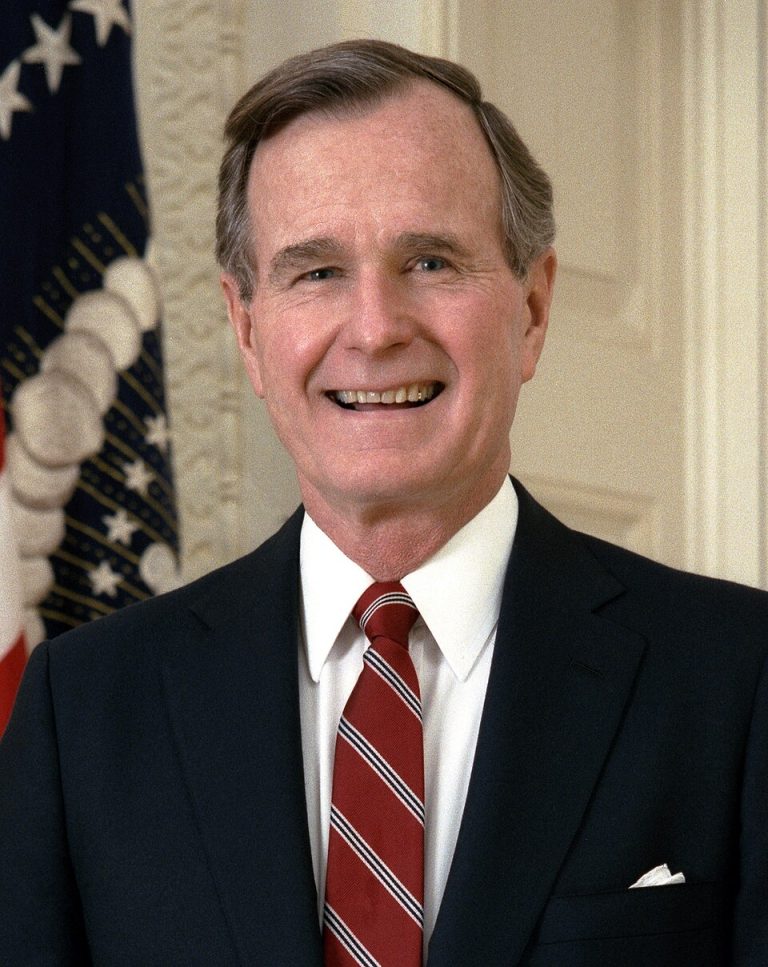
George H.W. Bush, the Loan Guarantees Crisis, and the 1991 Showdown on Israeli Settlements
In the fall of 1991, President George H.W. Bush faced one of the most public and contentious confrontations in the history of U.S.-Israel relations. Fresh from the decisive American-led victory in the Persian Gulf War, Bush and his Secretary of State, James A. Baker III, sought to capitalize on the moment by launching a major Middle East peace initiative. At the center of the conflict stood Israel’s request for $10 billion in U.S. loan guarantees to help absorb a massive wave of Jewish immigrants from the collapsing Soviet Union. Bush conditioned progress on those guarantees on a freeze of Israeli settlement construction in the West Bank, Gaza Strip, and Golan Heights, and on Israeli participation in what would become the Madrid Peace Conference.
The episode produced Bush’s famous self-description as “one lonely little guy” facing a thousand lobbyists on Capitol Hill. It strained ties with Israeli Prime Minister Yitzhak Shamir’s Likud government, triggered intense lobbying by the American Israel Public Affairs Committee (AIPAC) and other pro-Israel groups, and carried lasting political costs for both leaders. It also demonstrated that a determined U.S. president could successfully use economic leverage to influence Israeli policy when he believed broader American interests—particularly the credibility of the United States as a mediator—were at stake.
Background: Immigration, Settlements, and Post-Gulf War Ambitions
The late 1980s and early 1990s brought a historic influx of Jews from the Soviet Union to Israel. Hundreds of thousands arrived, placing enormous pressure on Israel’s housing, employment, and infrastructure. Israel sought U.S. loan guarantees—essentially American government backing that would allow Israel to borrow money from commercial banks at lower interest rates and on longer terms—to finance the absorption of these immigrants.
The United States had long provided substantial military and economic assistance to Israel. However, successive administrations had opposed Israeli settlement construction in territories captured in the 1967 Six-Day War, viewing it as an obstacle to peace and a complication for U.S. diplomacy with Arab states. Bush and Baker were particularly firm on this point. They believed continued settlement expansion undermined American credibility as an honest broker and risked alienating Arab partners who had joined the U.S.-led coalition against Saddam Hussein.
Tensions were already high before the $10 billion request. In 1990–1991 the administration delayed a smaller package of $400 million in housing loan guarantees for months until Israel provided stronger written assurances that the funds would not support settlement activity in the occupied territories. Even after those assurances, reports of continued settlement building angered U.S. officials. Baker repeatedly complained that every time he arrived in Israel for diplomatic talks, a new settlement announcement seemed to greet him. He publicly described settlement activity as the single biggest obstacle to peace.
After the Gulf War ended in early 1991, Bush and Baker intensified efforts to convene an international peace conference. They wanted Arab states and a Palestinian delegation (linked to Jordan) to sit at the same table with Israel. Shamir’s government, committed to retaining control of the territories and expanding settlements, was reluctant. The loan guarantees became the administration’s principal point of leverage.
The September 1991 Confrontation
In the summer of 1991, Israel prepared to formally request the $10 billion package, spread over five years. Baker telephoned Shamir and asked him to delay the request so that it would not complicate the delicate diplomacy leading to the peace conference. Shamir refused. On September 6, 1991, Bush appeared with Baker and publicly asked Congress to defer consideration of the loan guarantees for 120 days. He argued that a heated debate over settlements at that moment could jeopardize the chance for peace talks.
Israel immediately submitted the formal request. Pro-Israel organizations, led by AIPAC, mobilized. Hundreds of activists—reports at the time spoke of roughly a thousand lobbyists—descended on Capitol Hill to urge lawmakers to approve the guarantees without delay or conditions. Many supporters framed the issue as purely humanitarian: helping Soviet Jews escape repression and start new lives. Linking the aid to settlements, they argued, was inappropriate and risked harming the U.S.-Israel relationship.
Bush responded with unusual bluntness. At a September 12, 1991, White House press conference, he defended his position forcefully. He reminded the public that American troops had recently risked their lives defending Israel from Iraqi Scud missiles during the Gulf War and that the United States already provided substantial annual aid. He then delivered the line that would define the episode:
“I heard today there was something like a thousand lobbyists on the Hill working the other side of the question. We’ve got one lonely little guy down here doing it.”
Bush also threatened to veto any legislation that approved the guarantees before the 120-day period ended. He insisted that domestic political considerations should not override the pursuit of peace. Public opinion polls at the time showed strong American support for the president’s stance. Congressional leaders, facing both White House pressure and the risk of a veto, ultimately agreed to the delay.
Madrid and the Political Aftermath
The 120-day postponement helped clear the path for the Madrid Peace Conference, which opened on October 30, 1991, under the co-sponsorship of the United States and the Soviet Union. For the first time, Israel sat at the same table with Syria, Lebanon, and a joint Jordanian-Palestinian delegation. Although the formal conference produced no immediate agreements, it launched bilateral and multilateral tracks of negotiation that continued for years and laid groundwork for later breakthroughs, including the 1993 Oslo Accords.
The loan guarantees themselves remained unresolved while Shamir remained in office. The dispute contributed to the political climate in Israel. In the June 1992 Israeli elections, Shamir’s Likud lost to the Labor Party led by Yitzhak Rabin. Rabin had campaigned in part on changing national priorities and was more willing to limit settlement activity. Shortly after taking office, Rabin met Bush at the president’s summer home in Kennebunkport, Maine. The two sides reached an understanding. In the fall of 1992, Congress approved the $10 billion in loan guarantees, with provisions allowing the United States to deduct amounts corresponding to Israeli spending on settlements beyond the 1967 lines.
The political price for Bush was significant. His share of the Jewish vote fell sharply—from roughly 35 percent in 1988 to about 11 percent in 1992. Many American Jewish organizations and leaders felt the “lonely little guy” rhetoric had unfairly singled out pro-Israel advocacy and risked fueling antisemitic tropes about dual loyalty or excessive Jewish influence. Bush later met with Jewish leaders and expressed regret that his words had caused offense, stating he had not intended to harm the community or revive ugly stereotypes. Nevertheless, the episode left a lasting mark on his relationship with a key constituency.
Legacy
The 1991 confrontation is often cited as one of the clearest modern examples of a U.S. president successfully applying economic pressure on Israel over settlement policy. Bush and Baker treated the special relationship as important but not unconditional. They prioritized what they saw as broader strategic goals: sustaining the post-Gulf War coalition, demonstrating even-handedness to Arab states, and advancing a diplomatic process based on land-for-peace principles rooted in UN Security Council Resolutions 242 and 338.
Later presidents observed the political costs Bush paid and generally approached similar disputes with greater caution, especially early in their terms. The episode also entered the permanent repertoire of debates about the influence of pro-Israel lobbying in American politics. Supporters of the lobby point out that Bush ultimately prevailed and that the relationship endured. Critics of Israeli settlement policy point to it as proof that U.S. presidents retain substantial leverage when they choose to use it.
George H.W. Bush did not seek to “check Israeli control” of the United States in any conspiratorial sense. He acted as a president convinced that unchecked settlement expansion damaged American interests and the prospects for peace. By linking a major financial request to concrete policy changes and by publicly facing down intense domestic lobbying, he forced a temporary pause, helped convene the Madrid Conference, and demonstrated the outer limits of presidential willingness to confront a close ally. The confrontation remains one of the most revealing chapters in the modern history of the U.S.-Israel alliance.
